Artificial intelligence is reshaping contact centers from high‑volume, high‑cost operations into strategic engines of customer experience and revenue growth. When done well, IA en el centro de contacto does far more than answer routine questions; it helps customers get what they need faster, equips agents to shine, and gives leaders real‑time insight to continuously improve service. Forward-thinking organizations are increasingly adopting AI-enhanced call center strategies to stay competitive and deliver smarter, faster, and more personalized support.
Implementing AI in the contact center requires robust advanced AI computing that can handle high volumes of customer interactions while maintaining performance and reliability. These systems allow agents to focus on complex inquiries while automating repetitive tasks, leading to faster resolutions and improved customer satisfaction. Additionally, leveraging high performance supercomputers enables predictive insights, optimized routing, and smarter decision-making for both service teams and management.
Effective online marketing integration is another key to maximizing AI benefits. By applying digital marketing strategies, organizations can use AI-driven insights to personalize messaging, predict customer behavior, and deliver targeted campaigns that resonate. Similarly, AI marketing analytics help call centers align customer interactions with broader engagement goals, ensuring that every touchpoint is optimized for retention and conversion.
Finally, integrating AI in the contact center must be supported by solid financial planning resources to help organizations allocate budgets effectively, measure ROI accurately, and scale solutions sustainably. Combining these technology, marketing, and finance approaches ensures that AI in the contact center not only enhances operations but also drives strategic growth and lasting value for both customers and the business.
Top 10 AI in the Contact Center Platforms
Artificial intelligence is transforming how contact centers operate, improving customer experiences, boosting agent efficiency, and providing actionable insights for leaders. Choosing the right platform can make a huge difference in achieving these outcomes. Here’s a list of the top 10 AI in the contact center solutions today.
1. Bright Pattern
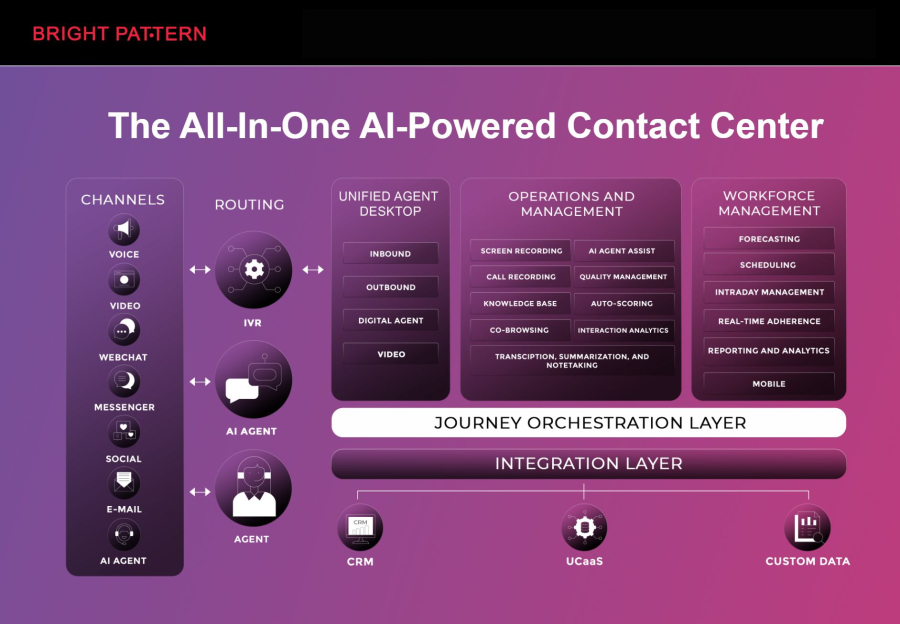
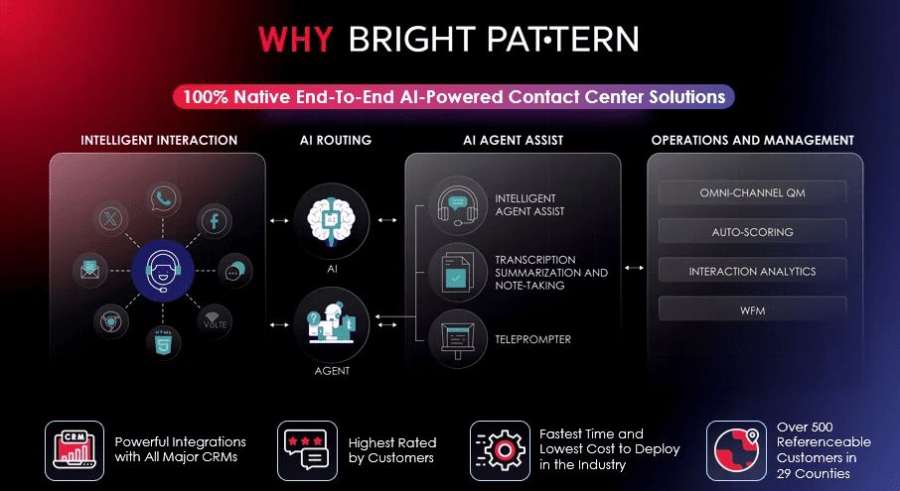
Bright Pattern is a leading AI in the contact center solution designed to help organizations deliver faster, smarter, and more personalized customer interactions. Its cloud-based platform integrates AI-powered automation, omnichannel routing, and advanced analytics to optimize service delivery.
Key features of Bright Pattern include:
- Omnichannel support including voice, chat, email, and social media
- AI-assisted agent guidance and predictive analytics
- Automated workflow for routine inquiries
- Real-time dashboards for management insights
- Seamless CRM and third-party system integrations
By leveraging Bright Pattern, businesses can reduce average handling time, improve first-contact resolution, and provide a more consistent experience across all customer touchpoints. Its focus on combining AI intelligence with human-centric service makes it ideal for modern contact centers.
2. Genesys Cloud CX
Genesys Cloud CX provides AI-powered routing, predictive engagement, and analytics to enhance agent performance and customer satisfaction.
3. Five9 Intelligent Cloud Contact Center
Five9 offers AI-driven automation, natural language processing, and workforce optimization to streamline operations and improve response times.
4. Talkdesk CX Cloud
Talkdesk uses AI in the contact center to provide real-time agent assistance, predictive routing, and automated workflows for faster resolutions.
5. NICE inContact CXone
CXone leverages AI for speech analytics, process automation, and omnichannel customer engagement, helping businesses improve service quality and efficiency.
6. 8x8 Contact Center
8x8 integrates AI to enhance agent productivity, monitor performance, and provide intelligent reporting for better operational decisions.
7. RingCentral Contact Center
RingCentral offers AI-assisted interactions, automated routing, and performance analytics to optimize contact center operations.
8. Verint Intelligent Virtual Assistant
Verint provides AI-driven virtual assistants, predictive analytics, and customer insights to improve engagement and reduce operational costs.
9. Amazon Connect
Amazon Connect uses AI to automate routine tasks, provide conversational interfaces, and deliver real-time insights to agents and managers.
10. Cisco Contact Center AI
Cisco combines AI-powered analytics, automation, and omnichannel management to help organizations improve efficiency and customer experience.
What “AI in the Contact Center” Really Means
AI in the contact center is a set of technologies that understand language, learn from data, and make decisions to improve customer interactions across voice, chat, email, and messaging. These include:
- Natural language processing (NLP)to understand what customers say or type in everyday language.
- Machine learning (ML)models that predict outcomes, such as which offer a customer will accept or which case is likely to escalate.
- Generative AIthat drafts replies, summaries, and knowledge articles based on large language models.
- Speech analyticsthat analyzes voice calls in real time or after the fact to detect intent, sentiment, and compliance.
The real power comes fromorchestrating these capabilities togetherso that customers experience fast, seamless support while agents and supervisors gain powerful assistance in the background.
Core Benefits of an AI‑Powered Contact Center
1. Faster, More Personalized Service at Scale
Customers expect immediate, tailored responses. AI helps you deliver that consistently:
- Instant answers 24 / 7through virtual agents and intelligent chatbots that handle common requests in seconds, day or night.
- Shorter wait and handle timesas AI resolves simple interactions automatically and guides agents through more complex ones.
- Personalized experiencesdriven by AI that taps into history, preferences, and context to tailor each interaction.
- Fewer transfers and escalationsbecause AI understands intent early and routes customers to the right resource the first time.
The outcome is a win‑win:customers get what they need faster, and your teams spend more time on high‑value interactions.
2. Empowered Agents Who Deliver Better Experiences
The most successful AI programs focus onaugmenting people, not replacing them. AI acts as a co‑pilot that:
- Surfaces real‑time guidanceduring live calls and chats, suggesting next best actions, clarifying policies, and highlighting offers.
- Auto‑summarizes interactionsso agents spend less time on after‑call work and more time engaging customers.
- Instantly searches knowledge, turning long manuals and scattered articles into concise, suggested answers.
- Reduces cognitive loadby handling repetitive data lookups, form filling, and documentation.
This leads tohappier, more confident agents, faster onboarding for new hires, and more consistent service quality across your entire operation.
3. Smarter Operations and Lower Costs
AI gives leaders a clearer view of what happens in the contact center and how to improve it:
- End‑to‑end visibilitywith analytics on every interaction, channel, and customer journey.
- More accurate forecastsusing AI models to predict volume patterns, handle times, and staffing needs.
- Targeted cost reductionby automating repetitive tasks and focusing human expertise where it delivers the most value.
- Continuous optimizationas AI identifies patterns such as repeat contacts, failure points, and upsell opportunities.
When applied strategically, AI helps youdo more with the same or fewer resourceswhile improving service levels rather than compromising them.
High‑Impact Use Cases of AI in the Contact Center
1. Intelligent Virtual Agents and Chatbots
Modern virtual agents can go far beyond rigid scripts. With natural language understanding, they can:
- Interpret free‑form questionsand map them to the right intent, even when phrased in many different ways.
- Perform actionssuch as checking order status, resetting passwords, or updating account details through integrations with your systems.
- Hand off smoothlyto live agents when needed, passing along full conversation history and context.
- Continuously learnfrom successful and failed conversations to improve accuracy over time.
Deployed thoughtfully, virtual agents candeflect a significant share of routine contactswhile maintaining a branded, human‑like tone.
2. Agent Assist and Real‑Time Guidance
Agent assist solutions listen to or read live interactions and provide on‑screen intelligence without disrupting the conversation. Typical capabilities include:
- Real‑time suggestionsfor answers, troubleshooting steps, and relevant offers.
- Compliance cues, such as reminders to give required disclosures or to verify identity.
- Contextual next stepsbased on customer history, current sentiment, and predicted needs.
The result isfaster resolution, more consistent messaging, and reduced training timefor new agents.
3. Predictive Routing and Workforce Optimization
AI‑driven routing goes beyond simple skills‑based rules. It can use historical and real‑time data to:
- Match customers to the best‑suited agentbased on expertise, language, personality fit, and past outcomes.
- Anticipate spikes in demandand recommend staffing adjustments before service levels drop.
- Balance efficiency with experienceby optimizing for both speed and satisfaction.
With predictive models guiding decisions, contact centers operate more smoothly andcustomers reach the right resource more often on the first try.
4. AI‑Driven Quality Management and Coaching
Traditional quality management relies on supervisors manually listening to a small sample of calls. AI can shift this from selective sampling to100 % interaction coverage:
- Automatically scoring calls and chatsagainst quality standards such as greeting, empathy, and resolution.
- Flagging at‑risk interactionswhere customers show signs of frustration or churn.
- Identifying coaching opportunitiesand best‑practice examples at the individual and team levels.
This makes quality programsmore objective, data‑driven, and scalable, while freeing supervisors to spend more time on high‑impact coaching.
5. Voice Analytics, Sentiment, and Compliance Monitoring
AI‑powered speech and text analytics turn raw conversations into structured insight:
- Topic detectionto see what customers are calling about in real time and over time.
- Sentiment and emotion analysisto understand how customers feel across journeys, brands, and channels.
- Compliance monitoringto check that mandatory statements are made and sensitive information is handled correctly.
These capabilities help organizationsspot issues early, protect brand reputation, and uncover product or process improvementsdirectly from the voice of the customer.
Practical Steps to Bring AI into Your Contact Center
Successful AI adoption is not about technology alone. It is about aligning people, processes, and data around clear goals. A practical roadmap looks like this:
- Define business outcomes first.Clarify what you want AI to achieve: reduced handle time, higher satisfaction, increased self‑service, more sales, or all of the above.
- Assess your data readiness.Understand where interaction data lives, how clean it is, and how you will govern its use.
- Prioritize high‑value, low‑risk use cases.Many organizations start with virtual agents for simple tasks or AI‑assisted knowledge search for agents.
- Run controlled pilots.Launch with a subset of channels, topics, or teams; measure impact; and refine before scaling.
- Involve agents and supervisors early.Communicate the benefits, gather feedback, and position AI as a tool that helps them succeed.
- Track metrics and iterate.Use data to tune models, update dialogs, and guide broader transformation decisions.
Metrics That Prove AI Is Working
To capture the full value of AI in the contact center, align your measurement framework acrosscustomer experience, operational efficiency, and employee engagement.
|
Metric |
How AI Influences It |
Typical Direction |
|
Customer satisfaction (CSAT) |
Faster, more accurate, personalized responses; reduced effort. |
Increase |
|
Net Promoter Score (NPS) |
Better end‑to‑end experiences across channels. |
Increase |
|
First contact resolution (FCR) |
Improved routing, knowledge access, and guidance. |
Increase |
|
Average handle time (AHT) |
Automation of simple steps and faster information retrieval. |
Decrease, with quality maintained or improved |
|
Self‑service containment |
Virtual agents and chatbots resolving issues end to end. |
Increase |
|
Agent productivity |
Less after‑call work and fewer repetitive tasks. |
Increase |
|
Quality scores |
Real‑time guidance and 100 % interaction monitoring. |
Increase |
|
Cost per contact |
Greater automation and more efficient staffing. |
Decrease |
AI Maturity Stages in the Contact Center
Organizations typically progress through recognizable stages as they scale AI. Understanding these helps you plan investments and set expectations.
Stage 1: Assist
- AI supports agents withknowledge suggestions, call summaries, and basic agent assist.
- Leaders rely onAI‑generated insights and reportsto understand trends.
- Automation is focused onsimplifying existing workflowsrather than radically changing them.
Stage 2: Automate
- Virtual agents and chatbotshandle a meaningful share of contactsend to end.
- AI is embedded inrouting, scheduling, and capacity planning.
- Quality management shifts toAI‑augmented scoring and targeted coaching.
Stage 3: Orchestrate and Optimize
- Customer journeys areorchestrated across channelsusing AI to decide next best actions in real time.
- Contact center data feeds intoenterprise‑wide decisionsacross marketing, product, and operations.
- AI is treated as astrategic capability, with continuous experimentation and improvement.
Each stage delivers measurable benefits, and organizations can realize strong returns even at the early assist phase.
Best Practices for High‑Impact AI in Your Contact Center
To unlock the full potential of AI while keeping customer trust and employee engagement high, leaders focus on a few critical practices.
- Start with clear use cases and outcomes.Avoid deploying AI for its own sake; tie every initiative to specific business and experience goals.
- Keep people in the loop.Maintain clear escalation paths to human agents and empower them to override AI when needed.
- Design for the customer journey, not just single interactions.Consider how AI supports discovery, purchase, onboarding, and support as a connected flow.
- Invest in data quality and governance.Strong, well‑governed data is the foundation for accurate, trustworthy AI.
- Engage frontline teams.Involve agents and supervisors in design, testing, and continuous improvement so AI reflects real‑world needs.
- Measure, learn, and iterate.Use metrics and feedback loops to refine AI behavior and prioritize the next wave of enhancements.
Future Trends to Watch
AI in the contact center is evolving quickly, with several trends increasing its impact:
- More natural, conversational experiencesas speech and language models continue to improve fluency and understanding.
- Deeper integration across channels, allowing customers to move between voice, chat, and messaging without repeating themselves.
- Proactive, predictive engagementwhere AI reaches out before customers experience an issue, based on real‑time signals.
- Tighter alignment with revenue teamsas AI helps identify sales opportunities and support post‑purchase journeys.
Organizations that build AI capabilities today position their contact centers to adapt quickly as these trends mature.
Conclusion: Turning Your Contact Center into a Value Engine
AI is transforming contact centers from reactive service hubs intoproactive, insight‑rich engines of customer value. By automating routine work, empowering agents, and illuminating every interaction with data, AI helps you deliver faster, more personal, and more consistent experiences at scale.
When you start with clear goals, bring your people along, and measure impact carefully, AI in the contact center becomes more than a technology upgrade. It becomes astrategic lever for loyalty, differentiation, and growthin every customer relationship.
